Saturday, May 17, 2025

 ASE Forever?  It's been years, though.  I've since run games in Dwimmermount and now looking at Thracia and Arden Vul.  

Speaking of which the 3d6 Down The Line Arden Vul series is amazing.

In response to 74'a question just posted, yes that's me.  The name Grodog sounds familiar....but I can't quite place it?  


Monday, August 17, 2015

Robot Character Class - adding some flexibility

PC Race – Robots  
Requirements: none   Prime Requisite: CON   Hit Die: 1d8   Maximum Level: 10

Robots are uncommon in the anomalous world, but the ancients made vast numbers of them (“Why do the scientists keep making them?”) and many have been reactivated.  While robots in general vary widely in size and capability, all player character robots are humanoid in shape and size.  Robots are distinguished from computers by having positronic brains, endowing them with a degree of will and flexibility not seen in even the most powerful conventional AI.  

A robot PC is not an especially rugged or dangerous model at first but as it gains levels the robot improves itself with new parts, motors, sensors, and weapons.  These are built from random bits scavenged from other robots, found in storage, or purchased from Scientists.  A robot does not wear conventional armor, doing so interferes with their sensors.  They may wield any weapon or shield as a human does.  All robots start with an unarmed attack that does 1d4 damage.  This can be a pincer, drill, simply a blow from a metal hand, or whatever seems appropriate.

Robots are immune to poison, disease, parasites, and ‘person’ affecting magic.  Their positronic circuitry is sensitive to negative energy, meaning robots can lose levels, and they need oxygen for catalytic reactive purposes—basically the same as people need to breathe.  Robots attacked by rust monsters or similar effects take a 2d8 points of damage from each ‘hit’. 


Lvl.

Breath
Poison/
Death
Petrify/ Paralyze

Wand

Magic
1-4
14
11
12
14
15
5-7
11
8
9
11
12
8+
8
5
6
8
9

Robots can self-repair at a rate of 1 hit point per 8 hours.  The raw materials needed to do this are nothing special, either an environment providing miscellaneous techno-junk, or 1 GP of Robot Parts per HP.  Healing spells have no effect on robots, but those with the science skill can jury rig repairs to a robot, each success heals 1 HP per level of the robot.  This can only be done to a robot once per day. 


Level

 XP

HD

THAC9
Robo-Points™

AC
1
0
1
10
1
9
2
2500
2
10
2
8
3
5000
3
10
3
7
4
10,000
4
9
3
6
5
25,000
5
9
4
5
6
50,000
6
8
4
4
7
100,000
7
8
5
3
8
200,000
8
8
5
2
9
350,000
9
7
7
1
10
500,000+
10
7
7
0
RoboPoints™ and robot advancement: when a robot gains a level it gains RoboPoints that can be spent on various improvements.  There is some expense, 100 GP of robot parts per RoboPoint spent. The first time an improvement is purchased it costs 1 RoboPoint.  Buying it again costs 3 points, then 5, then 7.  Most improvements are limited to four ‘levels’. 

StatBoost: adds 1d3 to any ability score to a maximum of 18.  Each score is a separate improvement.

MultiSwing: adds one unarmed attack per round.  Every level beyond the first represents an extra arm as well.  No more than three levels can be purchased.  The first level of this improvement costs 3 RoboPoints, then 5, then 7.  No extra attacks are gained with weapons held, only unarmed attacks.

HitBoost: improves the robot’s unarmed attack damage by a die type (d6, d8, d10, then d12).  This can represent buzz saws, retractable spikes or blades, etc. 

HoverJets: Repulsor motors allow the robot to hover, and at higher levels thrusters allow forward movement.  Max height equals 15’ x improvement level.  Speed equals 20 x (improvement level – 1).

Built-in ranged weapon: the weapon must be provided.  It can be a crossbow, gun, or energy weapon.  Ammunition must be provided.  All built in ranged weapons can be fired as a single action.  This improvement can only be purchased three times.

Modularity: doubles the effects of normal repairs (x3, x4, x5 at higher levels).  Each level purchased also allows the robot to be jury-rigged an extra time per day.

SensorBoost: the first level adds IR vision.  The second adds tremor sense.

CommandVoice: each level gives a one point benefit to reaction rolls from other robots.  A robot with at least one point in this can establish a Secret Base at 8th level, gaining five robot followers per level of CommandVoice.  Max of four levels of improvement.

GroundPounder: each level adds 10’ to tactical move, 30’ to normal move.  Max of four levels.

Load Bearing: adds 30#, cumulative per level to carrying capacity (+40/+80/+120/+160)
Install Device: any non-weapon technological device obtained can be installed inside the robot.  It can’t weigh more than about ten pounds.  Some degree of self-power or free uses per day may be possible, this is too variable a factor to give rules for.  The DM will determine any such benefit before you do it.

PositronShield: grants a saving throw vs. magic to avoid energy drain.  Each extra level adds four to the roll. 


Reslilience: one level in this removes the need to breathe and grants immunity to vacuum.  Each level beyond that grants resistance (+4 saves, -2 per die of damage) to either fire, cold, electricity, or acid.

Sunday, August 2, 2015

Haunting Custodian

The name 'Haunting Custodian' comes from AD&D but I always found the creature (aka the 'Drelb') somewhat dull.  Here's my take on a creature of this name:

No. Enc: 1

Alignment: Neutral
Movement: 90'
AC: 3
HD: 3+1
Attacks: 1
Damage: 1d4 + root
Save: F6
Morale: 8
Hoard: none

Haunting Custodians, also known as Drelb, are a type of earth elemental summoned and bound to a particular building or dungeon to maintain it.  They 'put things to right', resetting traps, closing doors, repairing damage and generally trying to keep things as they are.  


These creatures appear as 4' tall stone humanoids with brass beards.  Though quite strong they do not use weapons, and can only strike with a fist in combat.  However anyone standing on stone who is struck by one must save vs. magic or have the stone flow up over their lower legs, rooting them in place until the stone can be broken away (8 points damage from blunt weapons or picks, any excess damage being taken by the trapped creature).  They generally do not fight in any case, as they can move through stone as easily as air and tend to avoid confrontations.


Drelb can cause a variety of sounds to emanate from stone that they are within.  Knocking, tapping, even their rasping voice.  They will use this ability to annoy or disturb interlopers, or to draw dungeon dwellers to various locations, usually with a view toward making trouble for destructive invaders.  


As far as custodial functions, consider a drelb to be able to accomplish the work of five skilled and equipped miners or stonemasons.


Binding a drelb to service requires a fourth level MU spell.  The spell requires that the Custodian's 'pay'--one 100 gpv gem per year of service--be placed in an elaborately cast and carved stone and metal vessel that is  placed inside a magic circle in a room in the place to be guarded.  The magic allows the drelb to remove a single gem per year from this vessel.  (More can be added to extend the term of the binding.)  If the magic circle is broken so is the Custodian's binding.  If freed it will often try to seize whatever of it's 'pay' remains before departing forever.


Saturday, July 18, 2015

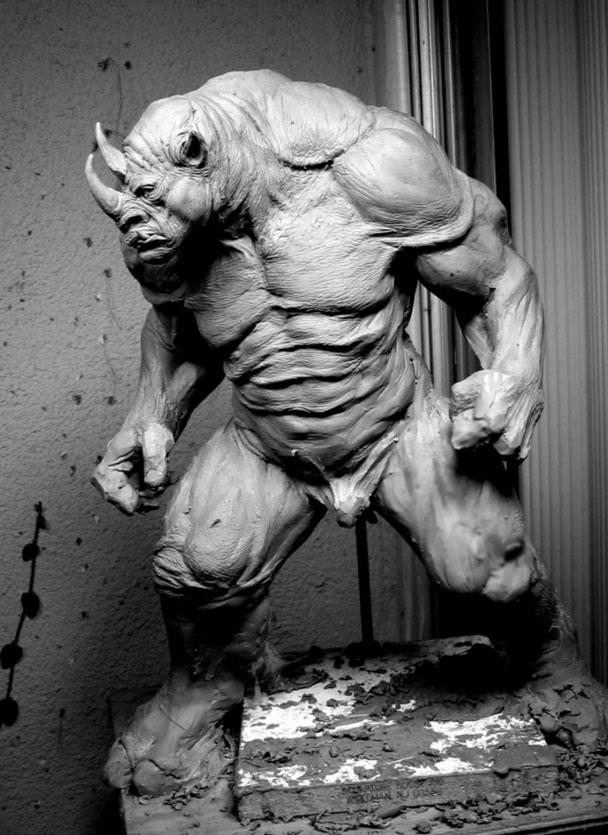
Rhino Men - an ASE Race

Picture source: http://dankatcher.deviantart.com/art/The-Rhino-86064039
No. Enc: 2d6 (5d6)
Alignment: Neutral
Move: 120’ (50’)
Armor Class: 6
HD: 2
Attacks: 1
Damage: d4+1 horn or by weapon + 1
SA: charge, yellow mold pots
SD: immune to disease, gas, mold
Save: F2, +2 on saves vs poison
Morale: 10
Hoard Class: individual - II, Lair - d6x100 gpv precious metal, d6-1 technological items

Rhino men (and women) are a highly factionalized race unique to the ASE.  These heavily muscled, horned humanoids are enemies of the hinge-headed—unsurprising, given that the schema o­f the rhino men race was emanated into the universe by extra-dimensional rivals of the hinge-headed specifically to thwart them.  

Rhino Men are well-suited to a dungeon environment, being able to eat almost any organic material and breathe easily in all but the most noxious atmosphere.  Smoke doesn’t bother them.  They exude chemicals that smell like cloves and render them immune to attack or infestation by any sort of mold or fungi. The clove smell is quite powerful; often it will be detected before the creatures themselves appear.   Anything that tracks by smell will have no trouble following their trail.

Rhino men are quick, bulky, and strong.  They are also relentlessly athletic and competitive.  If you use any sort of skill system grant these creatures bonuses to anything involving running, jumping, climbing, etc.  

For every four encountered one will be a brute.  For every seven encountered one will be a sage.  For every ten encountered one will be a hetman.
Brute: +1 HD, +1 damage
Sage: knows d4 of the following: Cure Light Wounds, P/F Normal Missiles, Resist Fire, Mirror Image, Dispel Magic, Magic Missile.  Caster level = the d4 roll.  After a spell is cast roll d6; on a ‘1’ it is expended for the day.
Hetman: +2 HD, +2 damage

In battle they favor spears and throwing axes, often unleashing a round or two of missiles before charging.  A charging rhino man who attacks with his horn may knock his opponent to the ground (50% if human sized, 25% for ogre, 75% for halfling, etc.).  The rhino man is allowed an immediate weapon attack if the knockdown is successful.    

For each leader type present, roll 1d4.  The total is the number of yellow mold grenades the group has.  These fragile clay pots do 1d6 on a direct hit, and fill a 5’ radius with spores—save vs. poison or d6 choking damage.   Of course the rhino men themselves are completely immune to the mold.  They often cultivate the stuff as a defense in their lairs.

Monday, November 17, 2014

Secrets of the Old City, and a map

Immersive Ink have published a revised version of their winning entry in the 2009 one-page-dungeon contest, Secrets of the Old City.  You can get a copy over here.  It's specifically for Delving Deeper, but of course easily converted to similar systems.

I liked it enough to prepare an unkeyed map for use with "fog of war"-enabled software.

This was just made by taking Simon Bull's original map, as rendered by Tim Hartlin, and carefully stripping out the location numbers and hidden elements (traps, mostly).  I also blocked out walls in front of all the secret doors so that if you're revealing the map one room at a time you can show a room without necessarily giving away the fact that there's a secret door in there.  Most of them had a fairly obvious "non secret" side, which made that a lot easier.  I also moved the torch sconce icons so that they were more-or-less entirely on the side of the wall where the torch exists, with no overlap across walls into other rooms.

I may gin up some notes on making this all a bit more "Anomalous"--I suppose the fact that my players have just returned to Denethis had something to do with my interest in an urban module.  So we'll see about that.

Sunday, November 9, 2014

Films Found in the ASE

Here's a description of some films I created for the players to find in the ASE, leftovers from the old Dynamat days:  The Three Films

Saturday, November 1, 2014

Anomalous Books: The Revelations of T'Son

The Revelations of T’son is a book which can be found in the Anomalous Subsurface Environment.  No one seems to know who T'Son is, but a few copies of the book have been circulating for at least a few hundred years.  It is a rambling manifesto of the sort written by paranoid maniacs in cabins in the woods.  All known copies are hand-written in tiny, crabbed script, usually on parchment of questionable origin.  It’s uncertain whether T’son himself produces all the copies, or others who wish to enshrine his ideas.

Revelations is a volume of natural philosophy centered on the four elements as building blocks of the universe.  All objects and creatures are composed of varying proportions of the four elements.  There is nothing uncommon about that but T’Son goes on to propose that earth (‘stone’ is his preferred rendering) is primary, and the father of the other three. All consciousness and will resides in stone except insofar as it chooses to impart these characteristics elsewhere. 

This theme is developed at great length to some surprising conclusions:
  • The deeper one goes the more blessed one becomes.
  • The Will Lies Below.
  • T’Son’s Hell is a shuddersome ‘abovestone’ location where the damned are tormented by ceaseless buffeting of uncontrolled waves, wind, and flames.
  • Liquid mercury is the distilled will of Stone and the fundament of the philosopher’s stone.
  • The undead are considered ambivalently.  They are ‘the blessed’ because they do not need to breathe, and are more are at one with stone in that regard.  However most human consciousness is insufficiently refined to withstand Stone’s rigor, which accounts for their malevolent and basically insane nature when turned into undead.  T’Son varies between envy and wariness in speaking of them.
  • The female is considered more earthly than the male and thus generally superior.  (T’Son’s own sex is strangely hard to discern from the book, pronouns and other self-references shift from largely male to mostly female as the book goes on.)  
  • Earth > Fire > Water > Air.  Air is equated with death, though he seems to conflate all manner of noxious vapors with air for this purpose.  Air with some degree of fire inhering in is breathable.
The book is at once a testament to the power of the ASE in promoting research and discovery, and evidence that Dynamat’s scientists were not the only ones to make use of this.  If T’Son had developed his strange philosophy in the customary Lunatic’s Cabin in the Woods all his furious concentration and theorizing would have led to nothing more than an unreadably long and tedious book, and perhaps the mailing of some pipe bombs.  However The Revelations is a fully functional spell book containing several novel elemental spells.  Magic Users and Elves can make use of these in the usual way.

Create Spring
Level 1
Duration: 1d10 hours
Create Spring causes a stream of water to emerge from earth or stone.  It produces one gallon of water per minute.  If a clear gem or crystal of 50gpv or more is used up in the casting the spring instead lasts for d10 days—and on a ‘10’ it is effectively permanent.  The surface upon which the spell is cast must be connected to the earth in general, not a mere block of stone sitting in a wagon, for instance.

Extract Fire
Level 2
Duration: instant
This spell can affect up to ten pounds per level of any flammable material, causing it to be immediately consumed in a blast of flame.  In the case of relatively flammable materials such as wood or coal this flame is substantial enough to damage those within five feet of the material, causing a d4 of damage per five pounds of material.  Less flammable things such as leather or mold will only cause half this amount of damage.  Other nearby materials may of course be set on fire as well.  If the item to be affected is carried by a creature it is allowed a saving throw to stop the spell from taking effect. 
Any item affected is reduced to a light, pumice-like, ashy stone skeleton of its former shape.

Trueflame
Level 2
Duration: until extinguished
Trueflame causes fire to act more in accordance with the odd elemental philosophy of T’Son.  It can be cast on any existing fire.  So long as it burns the fire produces no smoke (but twice the usual quantity of ash).  Oxygen in the air nearby is not consumed by the fire, in fact ‘dead’ air becomes refreshed and breathable once more(!)   More fuel can be added to a Trueflame fire, but the effect is localized.  Any flaming items removed from the enchanted fire do not convey the effect and burn normally.

Embrace of Stone
Level 1
Duration: one combat (d6 rounds per level if you’re into that sort of thing)
The Embrace of Stone can only be cast if standing on a stone surface.  It causes the stone to flow up and around the caster, providing an armor class equal to six minus the 'level' of the dungeon one occupies, to a minimum of zero.  However the effect is ponderous.  Any dexterity modifier to AC is lost and the caster’s movement rate is reduced to 90/30.  Above ground it has no effect other than to shower the caster with dirt.  

Stone Shape
Level 2
Duration: one minute per level
The caster is able to work solid stone as if it were heavy clay, though only with his bare hands.  Crude tools or weapons can be formed at the rate of one per minute.  Tunnels can be dug, though only at a rate of one cubic foot per minute.  A door can be dismounted from a wall with one minute’s work.

Voice of the Earth
Level 3

This largely duplicates the level 6 cleric spell Stone Tell.  The stone, however, is not compelled to answer specific questions.  Instead make a reaction roll to determine its disposition toward the caster.  On a negative reaction a dungeon elemental (or any indigenous creature outside the ASE) may be dispatched to bedevil the party.   

Friday, October 17, 2014

Yes, Skills. Don't kill me

Whether to have 'skills' in your game is a notoriously contentious subject.  I won't revisit the argument, but for my LL game I wanted to have a simple guide to deciding common situations where player description alone might not suffice.  I also wanted to allow for a somewhat greater degree of individualization for the characters while avoiding an "ever-escalating DC" kind of situation like one has with third edition.  What follows is the system I came up with.  It's based on Venger Satanis' system, but is less "Fate-y".
The only effect on the LL classes is that the thief skills table is junked (yay) and replaced with a larger-than-normal amount of skills for those characters.  You might make a 'thief' with none of the classic thief skills, so really they become more like 'Specialists' than anything.  
  
Skills
Characters can have three levels of competence in a skill: skilled, superb, and world-class.  Each level costs one point.  Specialists and halflings start with five points to spend and can purchase skilled or superb level training.  Characters in other classes start with three points to spend and are limited to the ‘skilled’ rating.  
As characters advance in level they get additional points to spend--specialists get one point every odd-numbered level, halflings every third level and other classes one per five levels. 
Resolution mechanic: “Making a skill roll” involves rolling a pool of d6’s.  Roll and note the highest result, see below for how you did.  If you got at least one 'six' then extra sixes indicate some degree of exceptional success, if that's even possible.  In all cases the result is basically a guide to how to look at or judge or narrate the attempt and its results.
Everyone always gets one die by default.  You get an extra die for being skilled, another for being superb, and another one if you’re world-class at the skill.  A character with 13 or more in the skill’s controlling attribute gets an extra die. A hard task subtracts one die while a stupendously hard task subtracts two.  Having excellent tools or a good “storyside” rationale adds a die.  If you end up with zero dice to roll you roll 2d6 and take the lower one.
                6 = total success                  
                5 = success, possibly with complications
                4 = partial success
                3 = failure, perhaps with a silver lining.
                2= failure
                1= critical failure
The skills and their governing attributes:

Athletics
Str/Dex
Bushcraft
Int/Wis
Diplomacy
Cha
Heal
Int/Wis
Intimidate                                 
Str/Cha
Knowledge: (specify)
Int/Wis
Linguistics
Int
Mechanician
Dex
Perception/Search
Int/Wis
Profession: (specify)
Int/Wis
Ride
Str/Cha
Sleight of Hand
Dex
Stealth
Dex
Swim
Str/Con
Skills with two attributes listed are amenable to different approaches (intuitive vs. analytical, etc.).  Use the higher of the two attributes for to see if you get the extra die for a high stat.

Skill Descriptions
Athletics – allows climbing, tightrope walking, tumbling past enemies, breaking down doors and similar feats of strength, etc.  Climbing is at 10’ per round, frequency of check depends on the surface (smooth wall=once per round, typical wall once per turn, mountains once per day).
Bushcraft – allows tracking, orienteering, ‘survival’ tasks, and animal handling.
Diplomacy – Only applies if a reaction roll is being made anyway. Grants a bonus on reaction rolls of +1 per level of skill.
Heal – allows restoring of one hit point on a roll of four or five, 1+1 per six on a roll of six.  Can be used after each fight.
Intimidate – can substitute for normal reaction rolls, though perhaps with lasting resentment.
Linguistics – being skilled grants literacy.  Superb or better grants the ability to puzzle out a bit of any language encountered.  This allows for scroll use—spells of level 3-5 are hard (deduct a die).  Higher level spells deduct two dice. 
Mechanician – Covers opening locks, disabling traps, and general low-tech mechanical operation or repair tasks.
Knowledge: various – there are numerous specializations possible here.  Some of particular use to adventurers:
Arcana – knowledge of magical items, spells, and magical paraphernalia. Includes knowing about monsters who are creations of magic or which cast spells/spell-like effects.
Religion – knowledge of various religions.  Includes knowing about the undead.
The Planes—knowledge of the various planes and extra-planar creatures such as demons and elementals.
Area—the ‘area’ can be anywhere, but by default is “the region we start in”.  Covers geography, politics, and common monsters found in the area.
Science—knowledge of the scientific marvels of the past.  And the not-so marvels.  Includes knowledge of robots or similar techno-creatures.
Other areas of knowledge are certainly possible.
Perception/Search – Covers search, spot, perception, finding secret doors, all that sort of thing.
Professions – These represent formal training at a specified trade or occupation.  Only a thief can have two professions to start with; starting members of other classes can have no more than one.  Some of the more interesting professions for adventurers: 
Actor – This governs any sort of disguise attempt, and is the skill used to tell convincing lies.  You can acquire either of these skills separately without it being a ‘profession’.  This is a CHA skill, unlike most professions.
Animal Training – Can teach a domestic animal one 'trick' per skill die.  (Attack, bear burden, etc.)  Wild animals, one less.  Hostile or fierce animals, two less.
Captain – Allows one to operate and repair watercraft, navigate, and manage the crew. 
Fencing Master—Training of combatants (often in swordcraft but not always).  Also grants the fencing master +1 to hit with a single type of weapons (melee or missile).  Superb level skill grants +1 with the other weapon type, and world-class converts the bonus with one type to +2.
Trapper/Leatherworker—Covers skinning and preserving of creatures and creature bits, setting simple traps, taxidermy, and turning hides to leather.
Armorer—Production and repair of armor and shields.  You’ll know if one you handle is magical, and have a good idea what plus it is.
Assassin—Covers poison use and striking for increased damage from behind or upon surprising an opponent. (x2 if level 0-4,  x3 if level 5-8,  x4 if higher level).
Weaponsmith—Production and repair of weapons.  You’ll know if one you handle is magical, and have a good idea what plus it is.
Less adventurous professions include: Farmer, Lumberjack/Carpenter, Miner/Stonemason, Jeweler/Gemcutter, Alchemist, Courtier, Lawyer, Scribe/Accountant, Artist, Engineer/Architect, etc.   
Ride – Anyone can ride a trained horse overland.  You’ll need the skill to employ a mount in combat or to control an untrained mount.  Controlling exotic or flying mounts is a hard task.  If riders are chasing each other (and have the same movement rate) ride rolls determine if pursuit is successful.
Sleight of Hand – Pickpocketing, shell games, prestidigitation, hiding things on your person, etc. 
Stealth – A roll of four or five succeeds but allows perception rolls to spot the sneak.  A roll of six just works.  This task becomes harder (deduct dice) in well-lit or open areas.  Wearing armor heavier than leather also imposes a penalty—one die for scale or chainmail, two dice for anything heavier.
Swim – The die roll x 10 is the percent of your actual movement that you get when swimming—a roll of one means you start drowning.  Roll once per round in combat, once per turn otherwise.  Note that even a modest amount of clothing and gear gives a one die penalty on swim rolls.